

If you have a $2 million or larger investment portfolio, choosing the right financial advisor is about more than investment performance. It is also about how much you pay for financial advice, what services you receive, and whether your advisor’s compensation structure aligns with your financial goals.
Two common options are flat-fee financial advisors and assets-under-management (AUM) financial advisors. Both can provide investment management and financial planning, but their fee structures can create very different costs as your wealth grows.
So, which is better for a $2 million+ portfolio?
The answer depends on your financial complexity, the services you need, and how you want to pay for advice. However, for investors with substantial assets who want comprehensive financial planning and investment management, a flat-fee financial advisor may offer a more predictable and cost-effective alternative to traditional AUM pricing.
But first, a little background.
Hello! I am Michael Hart. As a financial advisor for mid-career professionals in Princeton, New Jersey, my goal is to help young professionals build wealth.
Here is how the two models compare.
What Is the Difference Between a Flat-Fee and an AUM Financial Advisor?
The primary difference is how the financial advisor charges for services.
A flat-fee financial advisor charges a predetermined fee for an agreed-upon scope of services. The fee may be annual, quarterly, or project-based. It generally does not increase simply because your investment portfolio grows, although fees may change based on the services provided or the advisor’s pricing schedule.
An assets-under-management financial advisor charges a percentage of the assets being managed. The fee typically increases as the value of your managed portfolio increases, although some advisors use tiered pricing or negotiate lower percentages for larger portfolios.
For example, an investor with $2 million in managed assets paying a 1% annual AUM fee would pay $20,000 per year for advisory services. An investor paying a flat annual fee of $10,000 for a comparable scope of services would pay $10,000 instead.
These are illustrative figures, not quotes or industry-wide averages. Actual fees and services vary by advisor.
The important distinction is that AUM fees generally rise with portfolio value, while flat fees are tied more directly to the advisor’s pricing structure and scope of work.
How Much Does a Financial Advisor Cost for a $2 Million Portfolio?
The cost of financial advice can become a significant consideration when you have $2 million or more invested.
Consider the following illustrative comparison:
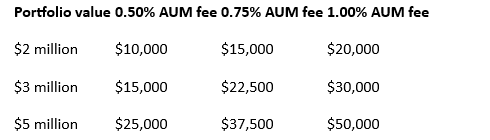
These figures assume the stated percentage applies to the entire portfolio for one year. They exclude other potential costs, such as fund expenses, trading costs, and separate planning fees.
Now compare those amounts with an illustrative flat annual advisory fee of $10,000.
At $2 million, a 0.50% AUM fee would equal the flat fee. At a 0.75% AUM fee, the annual difference would be $5,000. At a 1% AUM fee, the difference would be $10,000.
At $5 million, the same $10,000 flat fee would be $15,000 less than a 0.50% AUM fee, $27,500 less than a 0.75% AUM fee, and $40,000 less than a 1% AUM fee.
The comparison is meaningful only if you are comparing similar services. A flat-fee advisor who provides investment management and comprehensive financial planning is not necessarily comparable to an AUM advisor who offers a different level of service.
Still, the numbers illustrate why fee structure deserves careful consideration for investors with substantial assets.
Five Advantages of Flat-Fee Financial Advisors for High-Net-Worth Investors
1. Your Advisory Fee May Not Increase as Your Portfolio Grows
One of the biggest advantages of flat-fee financial planning is cost predictability.
Suppose your portfolio grows from $2 million to $3 million because of market appreciation, savings, or an inheritance. Under an AUM arrangement, your advisory fee may increase even if your financial circumstances and the services you need remain largely unchanged.
With a flat-fee arrangement, your fee may remain the same as your assets grow, depending on the advisor’s contract and pricing policies.
For investors who expect to accumulate additional wealth, this can be an important consideration.
2. You Can Separate the Cost of Advice From the Value of Your Investments
An AUM fee is calculated based on the assets being managed. This can make the cost of advice closely tied to portfolio size, even when the work required to manage your financial life does not increase proportionately.
A flat-fee model offers a different approach: pricing is based on the agreed-upon services rather than a fixed percentage of your investments.
For example, an investor with $3 million may need similar retirement planning, tax coordination, estate planning coordination, and investment oversight to someone with $2 million.
The amount of money invested is not always a reliable measure of the complexity of a financial plan.
3. You May Receive More Comprehensive Financial Planning
Some flat-fee financial advisors emphasize financial planning rather than investment management alone.
Depending on the engagement, services may include retirement income projections, tax-efficient withdrawal strategies, equity compensation planning, charitable giving, estate planning coordination, and evaluating major financial decisions.
This can be especially valuable for investors whose financial lives involve multiple moving parts.
However, do not assume that every flat-fee advisor offers all these services. Ask for a written description of what is included.
4. You May Have More Flexibility With Your Investments
Some AUM advisors require clients to transfer investment assets into accounts they manage. Other advisors offer different arrangements, so this is not a universal rule.
Flat-fee advisors may offer investment management, advice-only planning, or both. Depending on the arrangement, you may be able to retain existing investment accounts or implement recommendations yourself.
This flexibility can appeal to investors who want professional guidance without necessarily delegating every investment decision.
5. The Fee Structure May Better Fit Investors With Substantial Assets
Investors with $2 million or more may have accumulated significant wealth through disciplined saving, business ownership, equity compensation, real estate, or inheritance.
As their assets grow, they may want to reconsider whether a percentage-based advisory fee remains the most appropriate way to pay for financial advice.
A flat-fee model gives investors another option: paying an agreed-upon amount for defined services rather than automatically paying more as their portfolio increases.
The right choice still depends on the advisor’s expertise, the services provided, and the overall cost of the relationship.
When Does an AUM Financial Advisor Make More Sense?
Flat-fee advice is not automatically better for every investor.
An AUM financial advisor may be a good fit if you want someone to manage your portfolio on an ongoing basis, coordinate investment decisions, monitor your allocation, and handle implementation as part of a continuing relationship.
Some investors prefer having a single advisor responsible for ongoing investment management and financial planning. They may also appreciate the simplicity of having the advisory fee deducted directly from managed accounts.
An AUM arrangement may also be competitively priced for larger portfolios if the advisor offers reduced fee tiers.
The key is to determine whether the services justify the cost and whether you are comfortable with the compensation arrangement.
Ask the advisor to explain how the fee changes as your portfolio grows, what happens to the fee if your assets decline, and whether financial planning is included or charged separately.
Also, remember that an AUM fee does not automatically guarantee better investment performance or more comprehensive advice. Evaluate the actual services and the advisor’s approach.
How to Choose the Right Financial Advisor for a $2M+ Portfolio
Before choosing a flat-fee or AUM financial advisor, ask these five questions:
What is my total annual cost? Include advisory fees, investment expenses, trading costs, and any additional planning charges.
What services are included? Ask about retirement planning, taxes, estate planning coordination, cash flow, and investment management.
How does the fee change as my wealth grows? Understand whether market appreciation or additional contributions increase your cost.
How are you compensated? Ask about commissions, referral compensation, and other potential conflicts of interest.
Are you a fiduciary, and when does that duty apply? Understand the advisor’s obligations in the specific services and accounts involved.
Compare proposals based on the same scope of services. A lower fee is not necessarily a better value if important planning needs are excluded.
Look for an advisor who can explain complex decisions clearly, understands your financial circumstances, and provides services that match your needs.
Is a Flat-Fee or AUM Financial Advisor Better for a $2 Million Portfolio?
For many investors with $2 million or more, a flat-fee financial advisor is worth serious consideration because the fee can be more predictable and may not rise automatically with portfolio appreciation.
An AUM advisor may be the better choice if you value ongoing delegated investment management and the total cost is competitive for the services provided.
The best approach is to compare the total annual cost, scope of advice, investment management responsibilities, and potential conflicts of interest—not just the advertised fee.
The bottom line: If you have a $2 million+ portfolio, you do not necessarily need to pay a percentage of your assets to receive high-quality financial advice. A flat-fee advisor may provide the planning and investment guidance you need at a cost that is easier to anticipate as your wealth grows.
The most important question is not simply how much you have invested. It is what you need your financial advisor to do, how well that advisor does it, and whether the cost represents good value for your financial life.
Frequently Asked Questions
Is a flat-fee financial advisor cheaper than an AUM advisor?
A flat-fee advisor can be less expensive when the annual flat fee is lower than the percentage charged on your managed assets. The savings depend on portfolio size, the AUM rate, and whether both advisors provide comparable services.
How much does a 1% AUM fee cost on a $2 million portfolio?
A 1% annual fee on $2 million equals $20,000 per year, assuming the fee applies to the entire portfolio at that rate.
Why might a wealthy investor choose a flat-fee financial planner?
A wealthy investor may prefer flat-fee planning for predictable costs, a clearer connection between fees and services, and the ability to avoid automatic fee increases solely because investment assets appreciate.
Can a flat-fee financial advisor manage investments?
Yes. Some flat-fee advisors provide ongoing investment management, while others offer financial planning without managing assets. Confirm the advisor’s services, implementation responsibilities, and fee structure before engaging them.
Is an AUM financial advisor a fiduciary?
Some AUM advisors act as fiduciaries, but the fee model alone does not establish fiduciary status. Ask about the advisor’s legal obligations and when they apply.
What should I look for in a financial advisor with a $2 million portfolio?
Look for relevant experience, a clearly defined scope of services, transparent compensation, appropriate fiduciary obligations, and expertise in the planning issues that matter to you. Compare the total cost of advice with the value and quality of the services you receive.
If you're searching for a:
Fee-only advisor in Princeton, New Jersey
Flat-fee planner near Princeton, NJ
Retirement planner in Princeton NJ
Fiduciary financial advisor in Mercer County
Advice-only financial planner in Princeton, NJ
…I’d be happy to help.
Thanks for reading!
— Michael

Michael Hart, CFP® is an advice-only financial planner for mid-career professionals in Princeton, New Jersey.
P.S.
We are fee-only, flat fee advisors in Princeton, NJ who help mid-career professionals build wealth. If you’d like to meet with us to discuss retiring in New Jersey, how to create a financial plan for retirement, or any other topics related to your wealth, please set up a time.
Disclaimer
Advice Only, Public Benefit Corporation, dba Open Book Financial Planning, is an investment adviser registered with the Securities and Exchange Commission (CRD# 334039 / SEC File No. 801-135290). Our current disclosures, including Form ADV Part 2 and Form CRS, are available on our website at www.adviceonly.com
Source: ChatGPT
