

If you've started looking for a financial advisor, you've probably noticed something confusing.
One advisor says they charge 1% of your investments. Another says they charge a flat fee. Someone else charges by the hour.
So which is better?
The answer depends on what you're looking for—but understanding the difference could save you tens or even hundreds of thousands of dollars over your lifetime.
As an advice-only financial planner serving New Jersey and clients nationwide, I get this question almost every week. My firm operates on a flat-fee model because I believe clients deserve transparent pricing and advice that isn't influenced by how much money they have invested.
Let's break down the differences.
What Is an AUM Financial Advisor?
AUM stands for Assets Under Management.
Instead of charging a fixed dollar amount, an AUM advisor charges a percentage of the investments they manage for you.
A typical fee might be:
0.50%
0.75%
1.00%
More for smaller accounts
Here's a simple example.
If you have:
$250,000 invested
and your advisor charges 1%
You'll pay approximately $2,500 every year.
If your investments grow to:
$1 million
Now you're paying roughly $10,000 annually for essentially the same relationship.
Nothing necessarily changed.
You didn't suddenly require four times as much planning.
Your advisor simply earns more because your portfolio became larger.
What Is a Flat Fee Financial Advisor?
A flat-fee financial advisor charges a predetermined dollar amount, not a percentage of your investments.
That fee may be:
One-time
Monthly
Annual
The important part is this:
The fee is agreed upon before work begins.
Whether your investments are worth $200,000 or $2 million, your planning fee doesn't automatically increase simply because the stock market had a great year.
Many people appreciate that predictability.
What Is an Advice-Only Financial Planner?
This is where things become even more interesting.
Not every flat-fee advisor is advice-only.
An advice-only financial planner is a specific type of flat-fee advisor.
Rather than taking custody of your investments or charging to manage assets, an advice-only planner focuses on providing recommendations, education, and comprehensive financial planning while you keep control of your accounts. The emphasis is on delivering advice—not selling products or charging an ongoing percentage of your portfolio.
That's exactly how I work at Open Book Financial Planning.
I help clients with:
Retirement planning
Investment strategy
Tax planning
Employee benefits
Equity compensation
Estate planning coordination
Cash flow
Major financial decisions
But you keep your investments wherever you want.
The value comes from the advice—not from having me move money between mutual funds.
Flat Fee vs. AUM: Side-by-Side Comparison
The biggest difference between a flat fee advisor and an advisor who charges AUM fees is that the flat fee advisor is not biased by how large the portfolio is. Regardless of where you hold your assets or how much money you have, you pay the same fee.
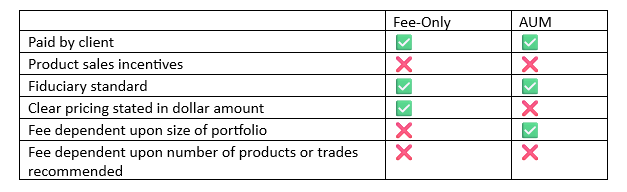
Neither model is automatically "good" or "bad."
The important question is:
Which pricing model best aligns with your needs?
Does Paying More Mean Better Advice?
Not necessarily.
Financial planning isn't like buying gasoline. Higher cost doesn't automatically equal higher quality.
Some outstanding advisors charge AUM.
Some outstanding advisors charge flat fees.
Some expensive advisors provide incredible value. Others don't.
The real question isn't:
"How much does the advisor charge?"
Instead ask:
"What am I actually receiving?"
A good financial planner helps you make smarter financial decisions across your entire life—not simply pick investments.
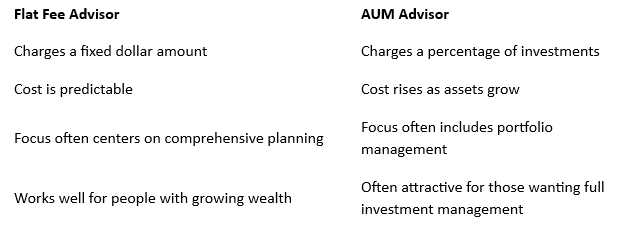
Why I Prefer the Flat Fee Model
When I launched Open Book Financial Planning, I intentionally chose to become an advice-only, flat-fee planner because I wanted the planning relationship to stay focused on the client—not the size of the client's portfolio. Transparency, education, and objective advice are central to how I believe financial planning should work.
I like knowing exactly what my clients pay.
My clients like knowing exactly what they'll pay.
No surprises.
No wondering whether transferring another account changes the bill.
Just straightforward pricing.
Who Benefits Most from a Flat Fee Advisor?
Flat-fee planning can be especially attractive if you:
Want comprehensive financial planning rather than investment management alone
Have multiple retirement accounts spread across different institutions
Want tax planning included
Have stock options or RSUs
Own real estate
Are nearing retirement
Prefer transparent pricing
Like staying involved in your own investments
Many people today are perfectly capable of placing trades online.
What they really need is someone to help them answer the bigger questions.
Who Might Prefer an AUM Advisor?
There are situations where an AUM relationship may make sense.
For example:
You don't want any involvement in managing investments.
You prefer delegating day-to-day portfolio implementation.
You value having someone execute trades on your behalf.
You want an advisor who actively manages the investment accounts directly.
If that's what you're looking for, an AUM relationship may be a reasonable fit.
The important thing is understanding how you'll be charged and what services are included.
Questions to Ask Any Financial Advisor
Before hiring anyone, ask:
How are you paid?
Are there any commissions?
What services are included?
Is tax planning included?
Will you review my employee benefits?
Do you provide retirement income planning?
How often will we meet?
Can I keep my accounts where they are?
Are you acting as a fiduciary?
How does your pricing change as my wealth grows?
Read this article for more questions to ask a financial advisor. These questions often reveal far more than a glossy website ever could.
So...Which Is Better?
The better model is the one that aligns with your goals, preferences, and the type of relationship you want with your financial planner.
If you want someone to manage investments for you and you're comfortable paying a percentage of your assets, an AUM advisor may be the right fit.
If you value transparent pricing, comprehensive planning, and objective advice without your fee automatically increasing as your portfolio grows, a flat-fee model—and especially an advice-only financial planner—may be exactly what you're looking for.
At Open Book Financial Planning, I believe financial advice should be easy to understand, free from unnecessary complexity, and centered on helping you make better financial decisions. Whether you're planning for retirement, navigating taxes, evaluating investments, or simply trying to gain confidence in your financial future, the focus should always be on creating a thoughtful strategy that serves your goals—not on how much money sits in an investment account.
If you're searching for a:
Fee-only advisor in Princeton, New Jersey
Flat-fee planner near Princeton, NJ
Retirement planner in Princeton NJ
Fiduciary financial advisor in Mercer County
Advice-only financial planner in Princeton, NJ
…I’d be happy to help.
Thanks for reading!
— Michael

Michael Hart, CFP® is an advice-only financial planner for mid-career professionals in Princeton, New Jersey.
P.S.
We are fee-only, flat fee advisors in Princeton, NJ who help mid-career professionals build wealth. If you’d like to meet with us to discuss retiring in New Jersey, how to create a financial plan for retirement, or any other topics related to your wealth, please set up a time.
Disclaimer
Advice Only, Public Benefit Corporation, dba Open Book Financial Planning, is an investment adviser registered with the Securities and Exchange Commission (CRD# 334039 / SEC File No. 801-135290). Our current disclosures, including Form ADV Part 2 and Form CRS, are available on our website at www.adviceonly.com
Source: ChatGPT
